Clinical Case Video
Immediate Full-Arch Reconstruction Utilising a Comprehensive Guided Surgical and Restorative Protocol
This video is intended for use in case discussions, especially for Study Clubs.
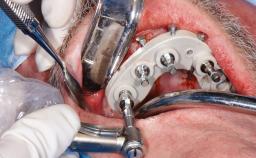
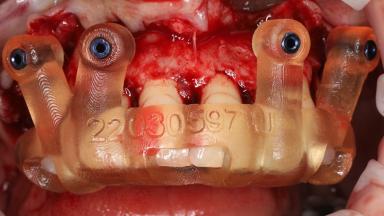
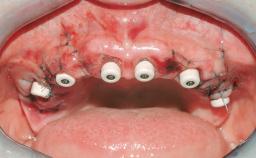
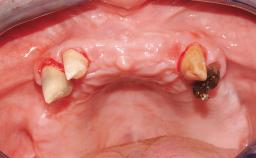
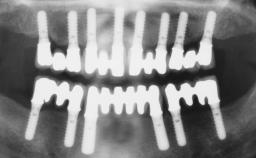
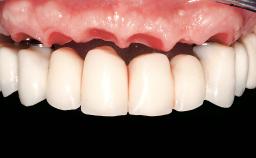
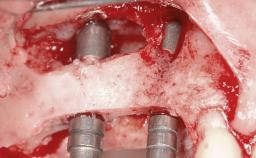
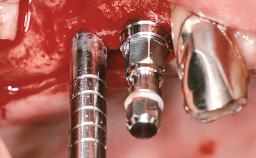
In this video Dr. Legg will demonstrate the process of utilising fully guided surgery as well as reconstruction to provide immediate full arch rehabilitation. A 56-year-old female with chronic adult periodontitis had previously undergone significant nonsurgical periodontal therapy. Unfortunately she had reached the stage where she was no longer happy with the appearance of her teeth and was suffering from increasing discomfort. A full workup was carried out in conjunction with a technical design team (at Createch). This included digital wax up of the proposed teeth, digital placement of the proposed implants and the design of the requisite surgical guides. The surgery was then carried out under sedation. The remaining upper teeth were removed, bone reduced where appropriate and the implants placed using a fully guided protocol. Following placement of screw retained abutments, the immediate provisional prosthesis was picked up in situ and passed to the technician for finishing before being fitted.
Produced in cooperation with The Campbell Academy.
Surgical classification
Complex
Prosthodontic classification
Complex
Duration
13 min.
Learner Level
|
1
|
2
|
3
|
CME/CPD
0.22 hours
Purchase price
7
You must be logged in to access or purchase this item.
There is a wealth of resources you can access by signing up
as an ITI Member. Learn more about ITI membership benefits.
General Risk Assessment
Patient-related Factors
| Oral hygiene | Good |
|---|---|
| Compliance | Good |
Patient-medical Factors
| Medical Fitness | Healthy, able to undergo planned anesthesia and surgical procedure (ASA I) |
|---|---|
| Medications | No medications that would negatively affect the surgical procedure and outcomes. |
| Radiation Treatment | None |
| Growth Status | Complete |
Site-related Factors
| Access | Adequate |
|---|---|
| Pathology near the implant site | None |
| Previous surgeries in planned implant site | No previous procedures. |
Surgical Classification
Surgical Complexity
| Timing of placement | Immediate Placement (extraction sockets) (Type I) |
|---|---|
| Simultaneous or Staged grafting procedures | Implant placement without adjunctive procedures |
| Number of implants | > Three |
Anatomy
| Keratinized Tissue | Sufficient (>4 mm) |
|---|---|
| Soft Tissue Quality | No scars or inflammation |
| Proximity to vital anatomic structures | Minimal risk of involvement |
Extractions
| Radicular morphology | Multi-radicular/divergent roots - available interseptal bone |
|---|---|
| Available apical bone to achieve primary stability | Sufficient height ( ≥ 4 mm) and width (> 2 mm around apex of planned implant) |
| Socket walls | Intact |
| Thickness of buccal wall | less than 2 mm |
| Inter-radicular bone (multi-rooted teeth) | Wide - allowing drilling and implant anchorage |
| Anticipated residual defect after implant placement | 2 mm or less |
Prosthodontic Classification
Complicating Factors
| Biological | Framework/Bar with appropriate contours and accessible maintenance procedures |
|---|---|
| Mechanical/Technical | Presence of non-critical contributing factors |
| Planned contour of tissue-fitting surfaces | Appropriate contours (hygienic - accessible for maintenance) |
Prosthesis Factors
| Prosthetic volume | Adequate. Space available for ideal anatomy of the restoration |
|---|---|
| Inter-occlusal space | Adequate. Capable to create an anatomically & functionally correct planned restoration |
| Volume and characteristics of the edentulous ridge (fixed) | Inadequate. Adjunctive therapy or prosthetic materials may be necessary to achieve optimal result |
Occlusal Factors
| Occlusal scheme | User-defined occlusal scheme achievable |
|---|---|
| Involvement in occlusion | Involved with guidance |
| Occlusal parafunction | Absent |
Complexity
| Loading Protocol | Immediate |
|---|---|
| Implant-supported provisional restoration | Required, elevated esthetic and/or functional demands |
| Number of implants | >2 (non-splinted) or ≥ 2 (splinted) |
| Timing of placement | Immediate Placement (extraction sockets) (Type I) |
Esthetic Risk Assessment
Edentulous Esthetic Risk Assessment (fixed)
| Facial Support | Alveolar process provides adequate facial support |
|---|---|
| Labial Support | Desired tooth position provides sastifactory labial support |
| Upper Lip Length | Long upper lip (>20mm) |
| Buccal Corridor | Wide Corridor |
| Smile Line | No display of the Maxillary ridge at full smile |
| Maxillomandibular Relationship | Class I |
Share this page
Download the QR code with a link to this page and use it in your presentations or share it on social media.
Download QR code