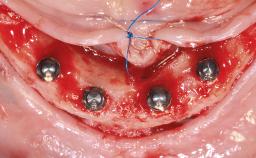
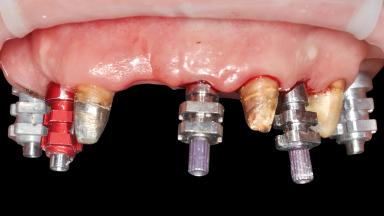
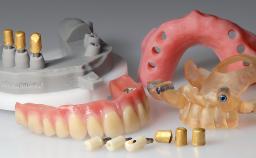
Treatment of a Hopeless Maxillary Residual Dentition with a Fixed Implant-Supported Restoration Using a Staged Approach
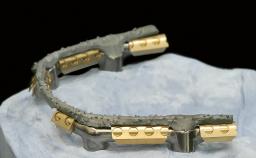
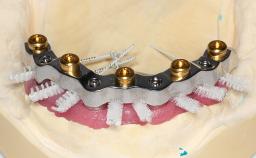
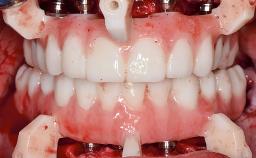
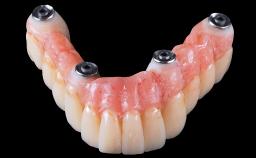
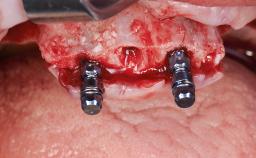
A 62-year-old male patient, a non-smoker, presented after 4 years without recall and with a history of recurrent abscesses on the maxillary central incisors. He was otherwise in good health but had history of periodontitis, so his associated risk was rated as moderate. His main complaint was difficulty with chewing, so he wanted to restore his dentition in the shortest possible time and without any removable provisional prosthesis. The patient wanted a definitive fixed restoration and was looking for an improvement in function, while maintaining the esthetics as much as possible.
Surgical classification
Complex
Prosthodontic classification
Complex
Learner Level
|
1
|
2
|
3
|
Source
Treatment Guide 15
CME/CPD
25 hours
Purchase price
10
You must be logged in to access or purchase this item.
There is a wealth of resources you can access by signing up
as an ITI Member. Learn more about ITI membership benefits.
General Risk Assessment
Patient-related Factors
| Oral hygiene | Fair |
|---|---|
| Compliance | Good |
Patient-medical Factors
| Medical Fitness | Healthy, able to undergo planned anesthesia and surgical procedure (ASA I) |
|---|---|
| Medications | No medications that would negatively affect the surgical procedure and outcomes. |
| Radiation Treatment | None |
| Growth Status | Complete |
Site-related Factors
| Access | Adequate |
|---|---|
| Pathology near the implant site | Condition that can be managed or does not need treatment |
| Previous surgeries in planned implant site | Previous procedures resulting in none or minimal bone and soft tissue changes. |
Surgical Classification
Surgical Complexity
| Timing of placement | Healed (Type IV) |
|---|---|
| Simultaneous or Staged grafting procedures | Implant placement as part of staged hard and/or soft tissue procedures |
| Number of implants | > Three |
Anatomy
| Bone Volume - Horizontal | Adequate |
|---|---|
| Bone Volume - Vertical | Moderate deficiency requiring simultaneous horizontal augmentation. Deficient, requiring a separate augmentation procedure prior to implant placement |
| Keratinized Tissue | Sufficient (>4 mm) |
| Soft Tissue Quality | Presence of minimal scars/no inflammation |
| Proximity to vital anatomic structures | High risk of involvement |
Prosthodontic Classification
Complicating Factors
| Biological | Framework/Bar with appropriate contours and accessible maintenance procedures |
|---|---|
| Mechanical/Technical | Presence of non-critical contributing factors |
| Planned contour of tissue-fitting surfaces | Appropriate contours (hygienic - accessible for maintenance) |
Prosthesis Factors
| Prosthetic volume | Adequate. Space available for ideal anatomy of the restoration |
|---|---|
| Inter-occlusal space | Adequate. Capable to create an anatomically & functionally correct planned restoration |
| Volume and characteristics of the edentulous ridge (fixed) | Inadequate. Adjunctive therapy or prosthetic materials may be necessary to achieve optimal result |
Occlusal Factors
| Occlusal scheme | User-defined occlusal scheme achievable |
|---|---|
| Involvement in occlusion | Involved with guidance |
| Occlusal parafunction | Present |
Complexity
| Loading Protocol | Early/Conventional |
|---|---|
| Interim prosthesis | Tooth supported |
| Implant-supported provisional restoration | Required, elevated esthetic and/or functional demands |
| Number of implants | >2 (non-splinted) or ≥ 2 (splinted) |
| Timing of placement | Healed (Type IV) |
Esthetic Risk Assessment
Edentulous Esthetic Risk Assessment (fixed)
| Facial Support | Alveolar process provides adequate facial support |
|---|---|
| Labial Support | Desired tooth position provides sastifactory labial support |
| Upper Lip Length | Long upper lip (>20mm) |
| Buccal Corridor | Wide Corridor |
| Smile Line | No display of the Maxillary ridge at full smile |
| Maxillomandibular Relationship | Class I |
Share this page
Download the QR code with a link to this page and use it in your presentations or share it on social media.
Download QR code